
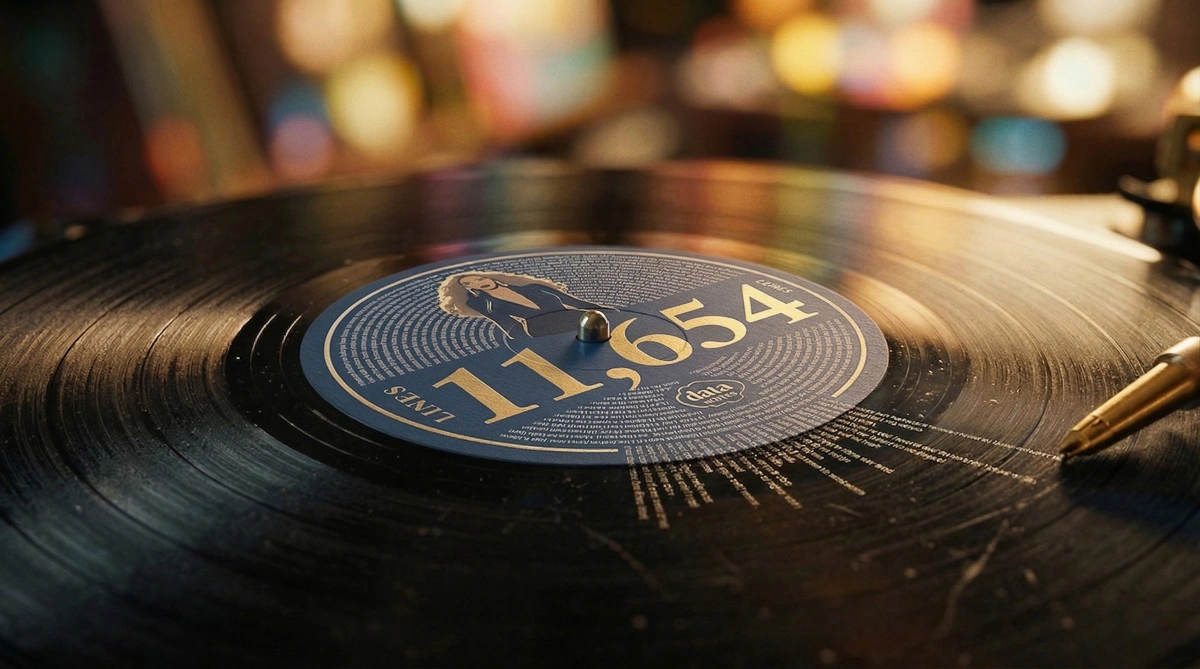
Half of every line Beyonce has ever written contains the word “I,” “me,” or “my,” and another third contains “you” or “your.” Together, those two pronouns account for almost 87 percent of the perspective in her catalog. “We” appears in just 5 percent of lines, “they” in 3 percent.
Across 224 original songs and 11,654 lines of lyrics (excluding remixes, live recordings, and alternate cuts from the TidyTuesday dataset), a computational analysis reveals something critics have felt but never quite quantified: Beyonce’s music constructs a two-person universe where it’s always “I” and “you,” locked in a room together, right now, tonight, and the rest of the world barely exists.
That intimacy isn’t an accident but an architectural choice that shows up in her word frequencies, her emotional patterns, her use of tense, and even in the way her songs arc from vulnerability to strength within their own runtime. Here’s what the data looks like when you count every word.
Her lyrics are a private conversation between exactly two people
The pronoun distribution across 11,654 lines is lopsided in a way that tells you everything about how Beyonce writes. First person dominates at 5,918 lines containing “I,” “me,” or “my,” with second person following at 4,209 lines addressing “you” or “your.” After that, there’s a cliff: “we” shows up in 622 lines, “he/him” in 356, “they/them” in 338, and “she/her” in just 270.
This stands out from the typical pop playbook, where empowerment anthems tend to use “we” (think Queen’s “We Will Rock You” or “We Are the Champions”) and political songs lean on “they” and “them.” Beyonce, even when she’s making a statement about all women (“Run the World”), frames it as “I” telling “you.” She doesn’t speak for the collective but to the individual, one listener at a time, letting the collective feeling emerge from 80 million people each feeling personally addressed.
The ratio holds even in her most political work. “Formation” and “Freedom” still center on first person declarations (“I slay,” “I’ma keep running”) delivered to “you.” What makes this work is that “you” is flexible enough to be a lover, an enemy, or every woman in the audience, depending on the song, so the intimacy becomes the delivery mechanism for the message.
She lives in the eternal present tense
Beyonce’s music doesn’t reminisce, and it doesn’t plan ahead; it happens right now. Lines containing “now,” “tonight,” or “right now” appear 413 times across the catalog, while lines referencing the future or eternity (“forever,” “always,” “tomorrow,” “someday”) appear just 155 times and the past tense (“yesterday,” “remember,” “used to,” “once”) shows up in 93 lines.
That’s a ratio of nearly 3 to 1 present over future, and 4 to 1 present over past.
This maps directly to what psychologists call the “earworm effect.” Research published in the APA’s Psychology of Aesthetics, Creativity, and the Arts found that present-tense urgency is one of the traits that makes songs stick in your head. A 2024 study in Scientific Reports analyzing 353,320 songs confirmed that pop lyrics have become more repetitive and present-focused over the last five decades, and that this shift correlates with commercial success.
Beyonce’s most present-tense word, “tonight” at 111 appearances, is also one of her most structural, setting the scene for nearly every sensual or celebratory song in her catalog. “Tonight” collapses time down to a single moment, which makes the emotion feel immediate rather than reflective. “Never” (223 appearances) is technically future-oriented but functions as a present-tense vow, because “I will never leave” is about commitment now, not about what happens in 2035.
One in three lines is a repeat, and that’s the point
The average Beyonce song repeats 27.8 percent of its lines. That means roughly one in three lines you hear in any given track is something you’ve already heard in that same song. But the range is enormous: from 0 percent repetition (pieces like “Yours and Mine” and “Trust In Me” are 100 percent unique lines) to 75 percent (“Hey Goldmember” repeats 39 of its 52 lines).
The Pudding’s landmark 2017 analysis of lyric repetition found that the average pop song in 2014 was 22 percent more compressible than the average song from 1960, with repetition increasing nearly every year. Beyonce’s 27.8 percent average puts her above that benchmark, but the spread across her catalog tells a more nuanced story: her most repetitive songs are dance tracks where the hook is the product, while her least repetitive work (“Yours and Mine,” “Gift from Virgo,” her spoken pieces) reads more like poetry or personal essay.
The word “halo” alone makes up 15.9 percent of all words in “Halo,” and the phrase “Who run the world? Girls!” accounts for 24.6 percent of its song. There’s a reason this works: research from the Journal of Consumer Psychology found that repetitive lyrics increase “processing fluency” (the ease with which your brain handles information) and that higher fluency directly predicts commercial success. Her repetition rates track closely with what the data suggests listeners actually want to hear.
The hooks that won’t let go
Some lines hit so hard they get repeated dozens of times within their songs, becoming the structural hooks that hold everything together.
The most repeated line in her catalog isn’t a power anthem but “That’s how you like it, huh,” a teasing, rhythmic hook that appears 48 times in a single song. “Who run the world? Girls!” comes in at 23, and “If I let you go,” a quiet statement of conditional devotion, at 20. The hooks that define Beyonce’s lyrical universe lean more toward intimacy and rhythm than empowerment.
Notice the pattern in the top hooks: most are about connection, longing, or the push-pull of a relationship (“If I let you go,” “Know that I can’t get over you,” “I’ll be waiting,” “Got me looking so crazy”). The public Beyonce is the one who runs the world, but the lyrical Beyonce is the one who can’t let go.
Love dominates everything, 31 to 1 over hate
The word “love” appears in 721 lines and “hate” appears in 23, a ratio of roughly 31 to 1. But the emotional picture gets more interesting when you look at what Beyonce does with love: she doesn’t just sing about it as a concept but deploys it in specific grammatical constructions that reveal different relationships to the feeling.
The active constructions (“I love,” “love you,” “my love”) outnumber the passive ones (“your love,” “love me”) by 323 to 117, meaning she’s the one doing the loving nearly three times more often than she’s asking to be loved. Even her relationship to love is assertive: she doesn’t wait for it, she declares it.
And when love goes wrong, she doesn’t dissolve but draws lines. Her most common negation patterns reveal a songwriter who refuses more than she grieves: “I don’t wanna” (35 times), “I ain’t sorry” (26 times), “I don’t care” (13 times), and “I won’t let you go” (8 times), with the refusals outnumbering the laments by a wide margin.
Her songs start vulnerable and end empowered
Across 187 songs with at least 20 lines, a consistent emotional arc emerges when you compare the first quarter of each song to the last quarter. Vulnerability language (“cry,” “broken,” “hurt,” “alone,” “lost”) drops 30 percent from opening to closing, while empowerment language (“run,” “power,” “strong,” “rise,” “free”) rises 29 percent and romance language rises 20 percent.
This isn’t random but a structural pattern baked into her songwriting. The Beyonce song formula, as revealed by the data, moves through a sequence: acknowledge the pain, process the feeling, arrive at strength or love or both. The Lemonade visual album, with its chapter titles “Intuition,” “Denial,” “Anger,” “Apathy,” “Emptiness,” “Accountability,” “Reformation,” “Forgiveness,” “Resurrection,” “Hope,” “Redemption,” is the macro version of what her individual songs do on the micro level.
Warsan Shire, the Somali-British poet who wrote the spoken-word interludes for Lemonade, provided the literary scaffolding for this arc. But the data shows Beyonce was already doing it structurally before Lemonade. It’s embedded in the songwriting, not just the concept album.
Desire and sensuality are the emotional bedrock, not empowerment
When people think of Beyonce, they think “empowerment,” but the data tells a different story about what her catalog is actually about. Desire and longing (“want,” “need,” “miss,” “waiting”) appear in 60 percent of her songs, sensuality and body (“touch,” “kiss,” “feel,” “body”) in 56 percent, and heartbreak in 32 percent. Joy and celebration come in at 20 percent. Confidence and power, the thing she’s most famous for? Just 16 percent.
Beauty and appearance, at 37 percent, rank just behind sensuality, meaning she sings about how things look and feel almost as often as she sings about wanting them. This gap between perception and reality is one of the most interesting findings in the dataset: the empowerment brand is built on a relatively small number of high-impact songs (“Run the World (Girls),” “***Flawless,” “Formation,” “Freedom”) that punch far above their numerical weight in the catalog, while the vast majority of her output is intimate, sensual, and emotionally complex.
The Chimamanda Ngozi Adichie sample on “***Flawless” (“We teach girls to shrink themselves…”) became a defining feminist statement, but it appears in exactly one song. “Formation” became a Black Lives Matter anthem that, as Time magazine reported, “had the greatest influence of all songs” on the 2016 presidential election, yet it’s one track in a catalog of 224. The political Beyonce is a real and important part of her identity, but the lyrical Beyonce is, by the numbers, a writer of love songs and body songs who occasionally turns that voice toward politics with outsized impact, partly because it’s unexpected.
The emotional math: what she amplifies and what she refuses
The ratios between emotional poles reveal a songwriter who is strategically, almost architecturally, positive while remaining honest about darkness.
“Beautiful” vs “ugly” is the most extreme ratio at 43 to 0 (“ugly” literally never appears in her original catalog), but “stay” vs “leave” is just 1.1 to 1 and “heaven” vs “hell” is 1.7 to 1. The closer you get to real relational tension, the more balanced the scales become. She’s not naively positive but selectively amplifying: the words she inflates (love, beauty, strength) are aspirational, while the words she keeps roughly even (stay/leave, trust/doubt) are the ones that live in the messy middle of real relationships.
The exception that proves the rule: “never” appears 223 times, dwarfing “forever” at 51, meaning she makes more vows about what she won’t do than what she will. This is a songwriter who defines commitment not through promises of eternity but through promises of refusal: I won’t leave, I won’t stop, I won’t let them take this from me.
There are 80,142 words in Beyonce’s original catalog, roughly the length of a novel, and within that corpus just 5,340 unique words. By the Pudding.cool methodology (which standardizes to the first 35,000 words for cross-artist comparison) Beyonce clocks in at 2,911 unique words, below Eminem’s 4,494 and well below Aesop Rock’s 7,392.
But vocabulary size is the wrong metric for what Beyonce does. She doesn’t need 8,000 words because she’s not trying to dazzle with lexical range; she’s using 5,000 words the way an architect uses steel, structurally and precisely, with repetition not as weakness but as load-bearing design. “Love” carries the emotional weight, “I” and “you” build the intimacy, “now” and “tonight” compress time into urgency, and the hooks (those lines that get repeated 15, 20, 48 times) are the rivets holding the whole structure together.
Eleven thousand lines. Two pronouns. One eternal present tense. That’s the blueprint.
Dataset used:
tidytuesday/beyonce-lyrics— The raw dataset contains 22,616 lyric lines across 391 songs. After filtering out remixes, live recordings, alternate versions, medleys, and Homecoming performances, the analysis uses 11,654 lines across 224 original songs. Filtering excluded songs whose names contain “Remix,” “Mix,” “Version,” “Live,” “Edit,” “Dub,” “Homecoming,” or “Medley” (case-insensitive).
Calculations & transformations:
- Pronoun analysis: Each line was checked for membership in pronoun groups (I/me/my/mine/myself, you/your/yours/yourself, etc.) using exact word matching with word boundary detection. Lines containing multiple pronoun groups are counted in each group.
- Temporal orientation: Lines were classified as present-oriented (containing “now,” “tonight,” “right now”), future/eternal (“forever,” “always,” “tomorrow,” “someday”), or past (“yesterday,” “remember,” “used to,” “once”) based on keyword presence.
- Repetition metrics: For each song, repetition percentage was calculated as
1 - (unique lines / total lines), where lines were lowercased and trimmed before comparison. - Emotional landscape: Songs were flagged for emotional themes using keyword clusters (e.g., desire/longing: “want,” “need,” “crave,” “miss,” “waiting”; confidence/power: “boss,” “queen,” “slay,” “flawless,” “power”). Each theme used 7-13 keywords. A song is counted once per theme regardless of how many matching lines it contains.
- Emotional arc: For songs with 20+ lines, the first 25% and last 25% of lines were separately classified using four keyword clusters (vulnerable, empowered, romantic, defiant). Totals were summed across all qualifying songs.
- Love construction analysis: Regex patterns matched specific grammatical constructions (“I love,” “love me,” “your love,” “in love,” “don’t love,” etc.) within each line.
- Vocabulary size: All words were extracted using
[a-z']+regex, lowercased, with tokens under 2 characters excluded. The 5,340 unique word count covers the full 80,142-word corpus. The 2,911 figure at 35,000 words matches the Pudding.cool methodology for cross-artist comparison.
Limitations:
- Remixes, live recordings, alternate versions, medleys, and Homecoming performances were filtered out by song name pattern matching. This filter is imperfect: some excluded songs may contain unique lyrics (e.g., remix verses by featured artists), and some included songs may be near-duplicates not caught by the filter.
- Keyword-based emotional classification is a blunt instrument. “Run” in “Run the World” carries different emotional weight than “run” in “run away.” Context-free word matching will misclassify some lines.
- The dataset has no album or release date metadata, so temporal analysis of how Beyonce’s writing has evolved over her career is not possible from this source alone.
- Songwriter credits and album timeline context referenced in the narrative come from Wikipedia, Billboard, The Wrap, and Pudding.cool, not from the TidyTuesday dataset.
Data accessed on 2026-04-04 via the OpenData API.